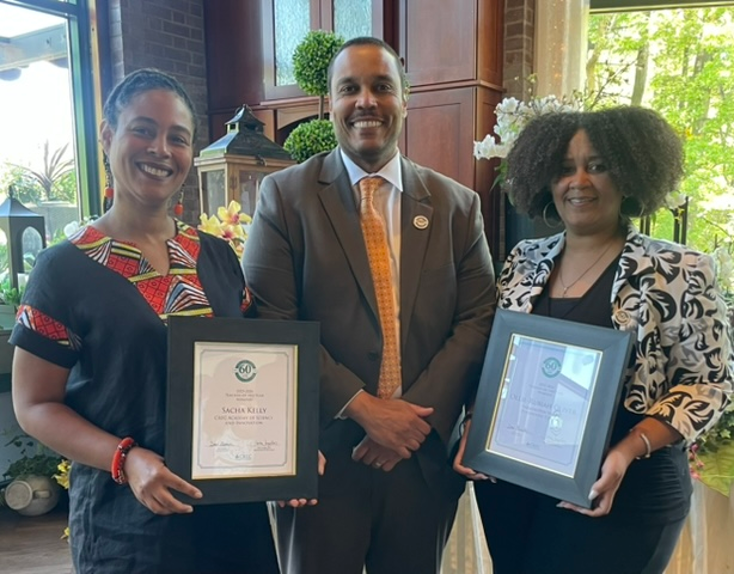
Sacha Kelly, left, and Ollie-Rubiah Oliver, right, with Desi Nesmith.
The Capitol Region Education Council (CREC) has honored two Alma Exley Scholars as Teachers of the Year at their schools. Bestowing the honor was Desi Nesmith, executive director of CREC, also an Alma Exley Scholar.
Recognized were Ollie-Rubiah Oliver, who teaches at the Farmington Valley Diagnostic Center in Simsbury, and Sacha Kelly, a mathematics teacher at the Academy of Science and Innovation in New Britain. The Alma Exley Scholarship Program honored Ms. Oliver in 2001 and Ms. Kelly in 2008. Mr. Nesmith was honored in 2000.
Honored with 19 Other Teachers
Mr. Nesmith feted them at a luncheon at the Pond House in Elizabeth Park in West Hartford along with 19 other Teachers of the Year from CREC schools. More than 12,000 students from 40+ towns in the Hartford Region attend 22 CREC schools in Hartford and 12 surrounding towns.
“It is a special privilege to recognize two fellow Alma Exley Scholars as Teachers of the Year,” Mr. Nesmith said. “Their achievements reflect not only their individual dedication and talent but also the lasting impact that great educators have on the lives of students every day.”
Both honorees have master’s degrees from the University of Saint Joseph. Ms. Oliver has a bachelor’s degree from Temple University, and Ms. Kelly has a bachelor’s degree from Trinity College and a Sixth-Year Administrative Certificate from Central Connecticut State University.
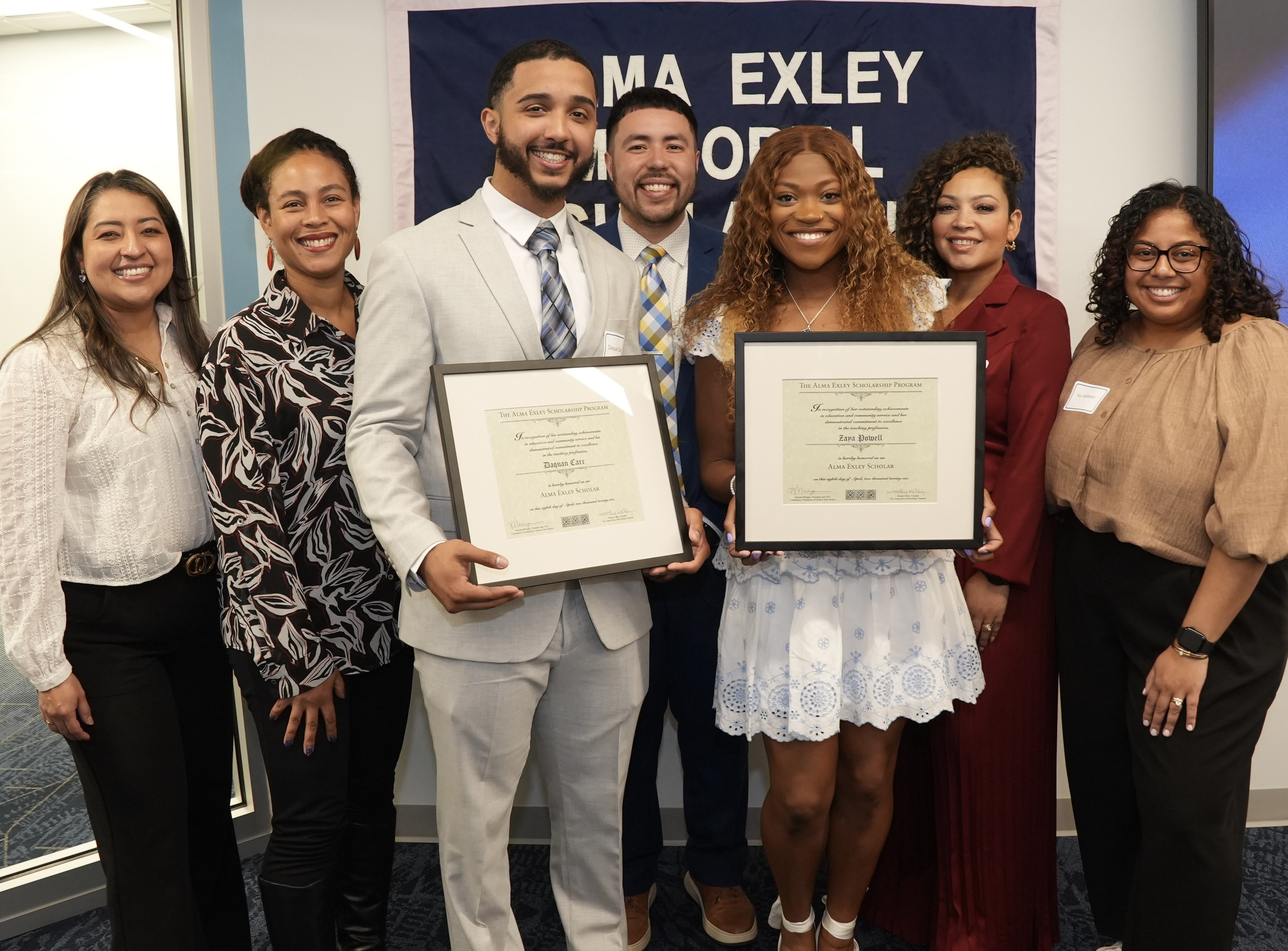
2026 Alma Exley Scholars Daquan Carr and Zaya Powell with previous scholarship recipients, from left, Verónica Alvarenga Ramos, Sacha Kelly, Orlando Valentin Jr., Dr. Violet Jiménez Sims, and Ivy Jackson.
Zaya Powell of Waterbury, a student at Southern Connecticut State University, and Daquan Carr of New Britain, a student at Central Connecticut State University, have been honored by the Alma Exley Scholarship Program.
They were feted by supporters of the scholarship program, including previous recipients, at an event at Charter Oak State College in New Britain. More than 40 attended in-person and half as many participated remotely via Zoom.
They are the 41st and 42nd students to be honored since 1995. Previous recipients are making a difference as teachers and educational leaders in Connecticut and across the country. The scholarship program is fulfilling the vision of the late Alma Exley, who had been working at the state Department of Education to achieve greater educator diversity.
CCSU Student
Mr. Carr holds a Bachelor of Science degree in Exercise Science and a Master of Science degree in Physical Education with a specialization in Exercise Science, both from Central Connecticut State University. He is enrolled in a post-baccalaureate, teacher-certification program at Central.
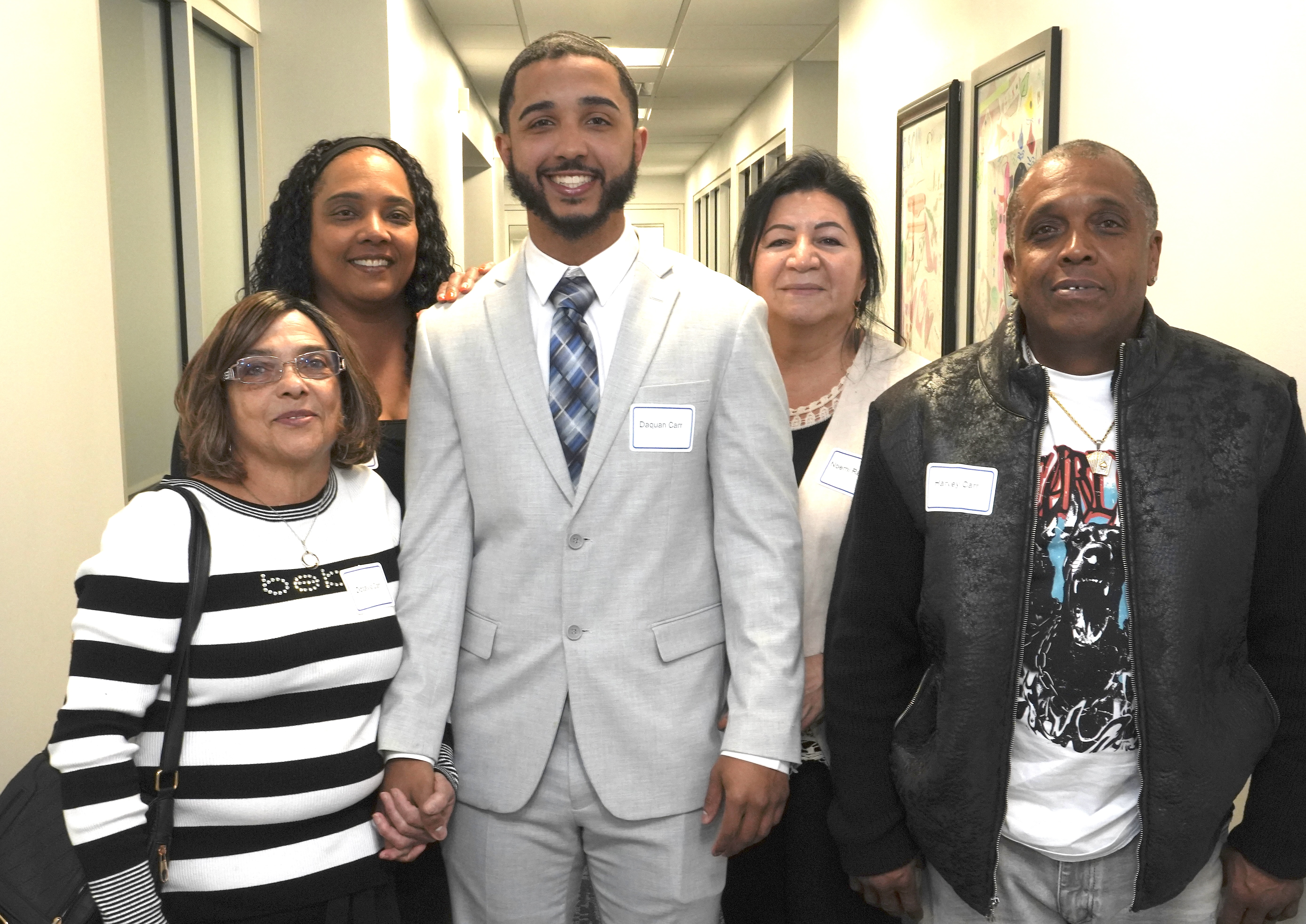
Daquan Carr with his family, from left, Octavia Carr, Monique Carr, Noemi Ramirez, and Harvey Carr.
He has a strong record of working with students and adults with physical and intellectual disabilities. As a volunteer at Savage House Gym in East Hartford, he has led fitness sessions for adults with intellectual disabilities. He has taught graduates of New Britain High School with disabilities who are in a transition program at Central.
Through programs like these, he has had an impact on a community that doesn’t have enough opportunity to enjoy movement activities with others. He recognizes that students with disabilities are often marginalized and don’t have the same opportunities for physical fitness as others.
SCSU Student
Ms. Powell is pursuing a master’s degree from Southern Connecticut State University with a concentration is science education. She’s also a registered nurse, with a bachelor’s degree in applied science from Monroe College in the Bronx. She has a bachelor’s degree with a major in chemistry from Hampton University.
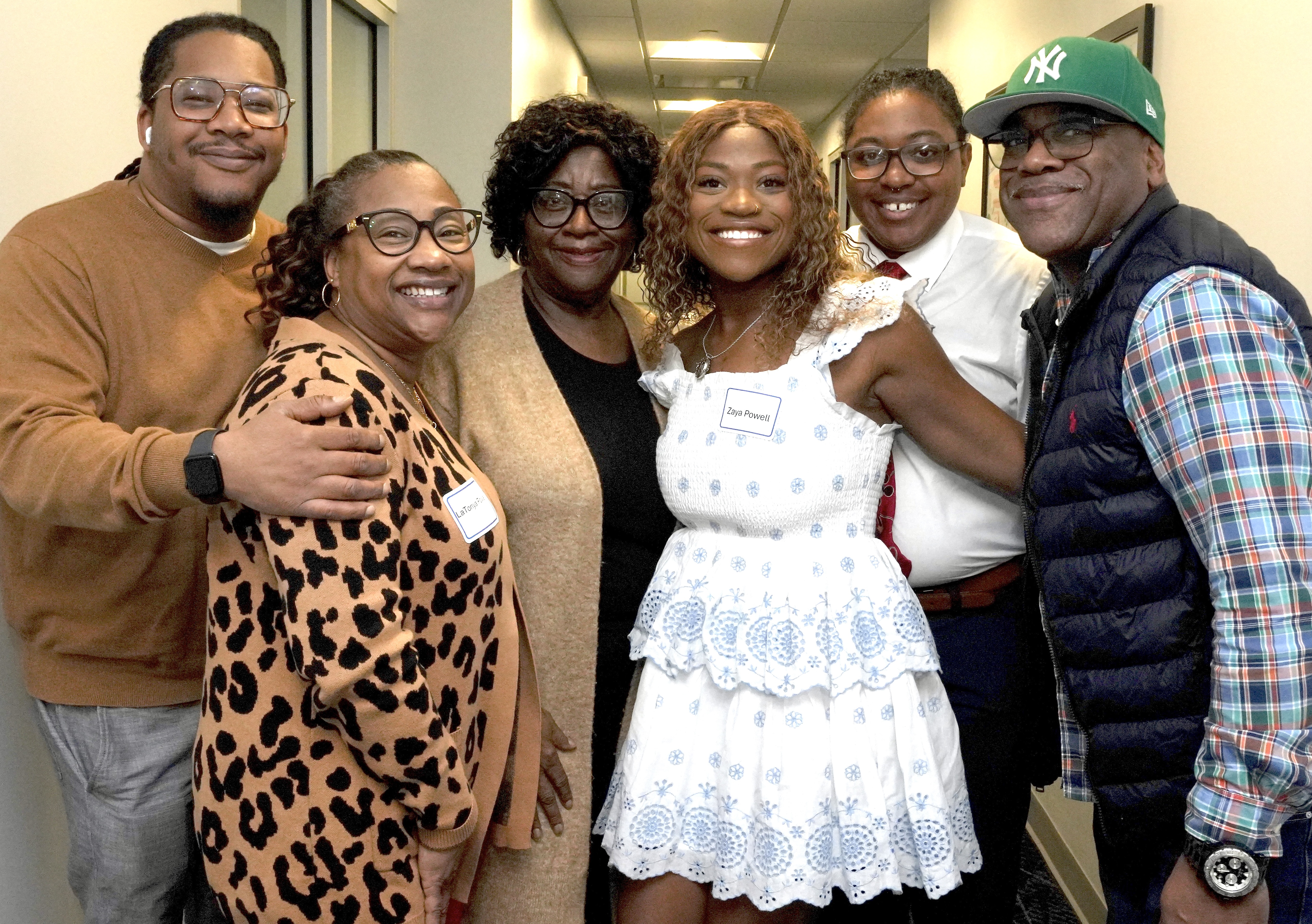
Zaya Powell with her family, from left, Darrell Powell, LaTonya Powell, Jeannette Powell, Kristina Bynum, and Devernon Parker.
She has long been involved in volunteer activities with a variety of organizations. At Hampton, she was a community organizer with the Black Leadership Organizing Collaborative. Also at the university, she tutored high school students and observed what she calls the transformative power of education.
She volunteered at St. Mary’s Hospital in Waterbury. She is a vice president with Petals and STEM, a non-profit that encourages young women of color to consider careers in science and math.
Diversity Champion
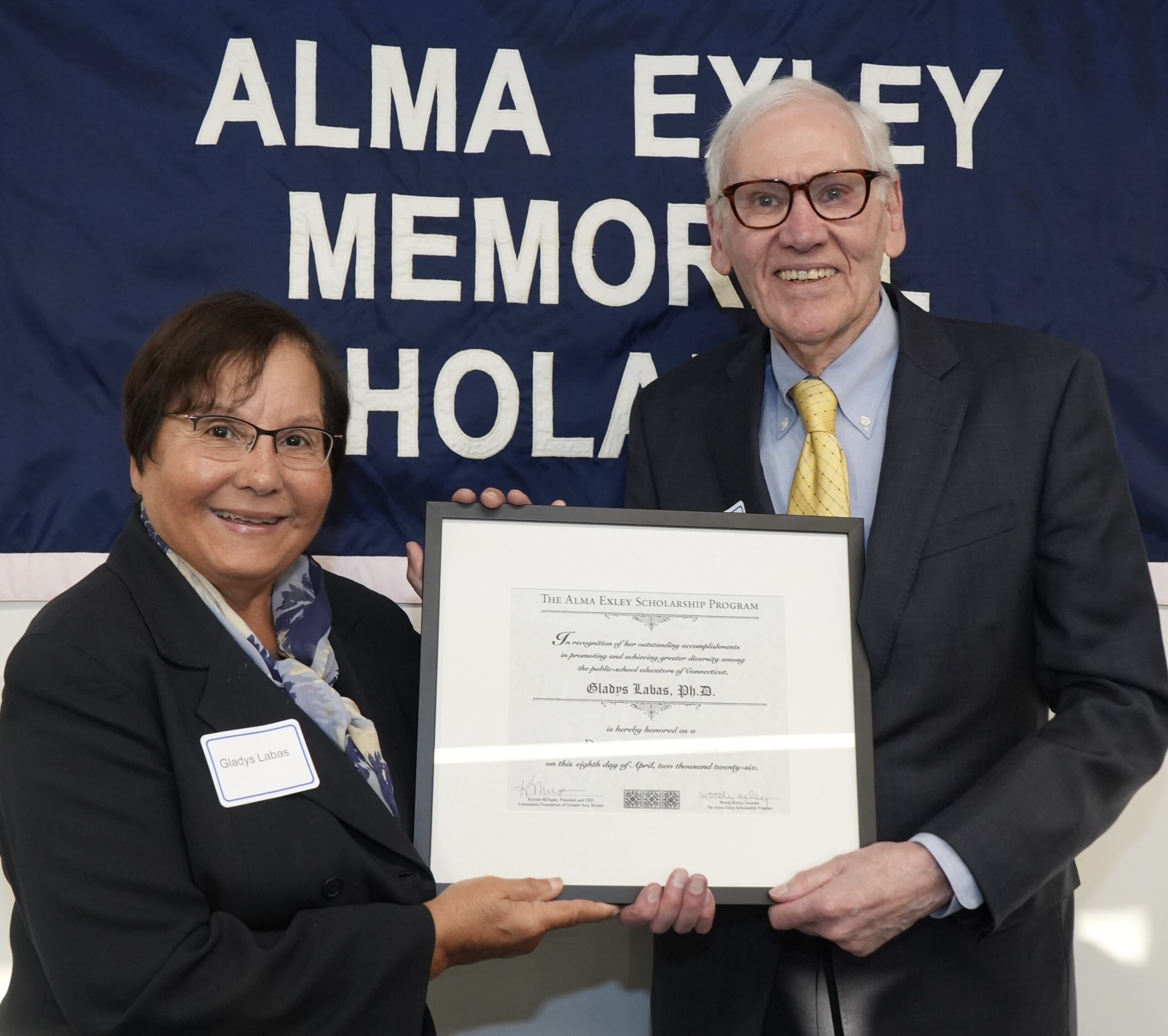
Dr. Gladys Labas was honored as 2026 Diversity Champion in recognition of her leadership in advancing equity and diversity among educators throughout the state and for her efforts to meet the needs of English-language learners.
Woody Exley presents Dr. Gladys Labas with certificate as 2026 Diversity Champion.
She has had an impact as a professor in the Department of Educational Leadership and Policy Studies at Southern Connecticut State University and previously as director of equity and language at the state Department of Education. And now she is making a difference as a member of the state Board of Education.
Throughout her career, she has been committed to advancing bilingual education. She had a big impact as co-author of Connecticut’s 1978 bilingual-education law. She led high-school reform initiatives with the Connecticut Association of Schools, serving as co-chair of the Achievement Task Force for English-Language Learners.
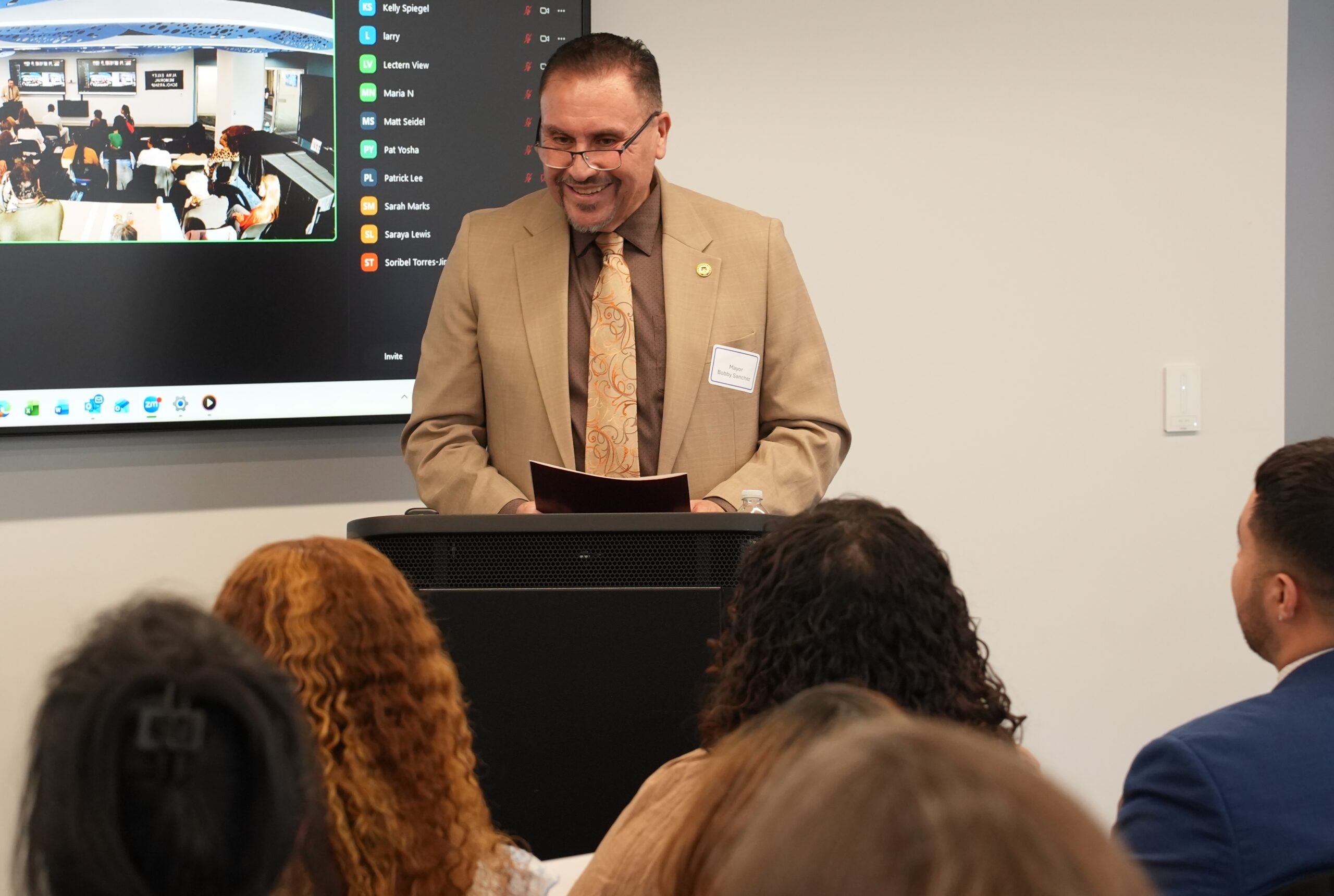
Mayor Bobby Sánchez welcomes attendees.
Mayor Bobby Sánchez welcomed the attendees on behalf of the City of New Britain. He was honored as Diversity Champion in 2023 for his initiatives during his tenure as co-chair of the State Legislature’s Education Committee.
Honoring Their New Colleagues
Previous recipients honored their new colleagues by attending in-person or on Zoom: Verónica Jazmin Alvarenga Ramos (2025), Soribel Torres-Jiménez (2023), Saraya Lewis (2022), Ivy Jackson (2019), Chastity Berrios Hernández (2017), Orlando Valentin Jr. (2016), Sacha Kelly (2009), Dr. Violet Jiménez Sims (2008), and Chi-Ann Lin (1999).
Mr. Valentin served as master of ceremonies. Ms. Kelly introduced Mr. Carr. Ms. Jackson introduced Ms. Powell. Dr. Jiménez Sims introduced Dr. Labas.
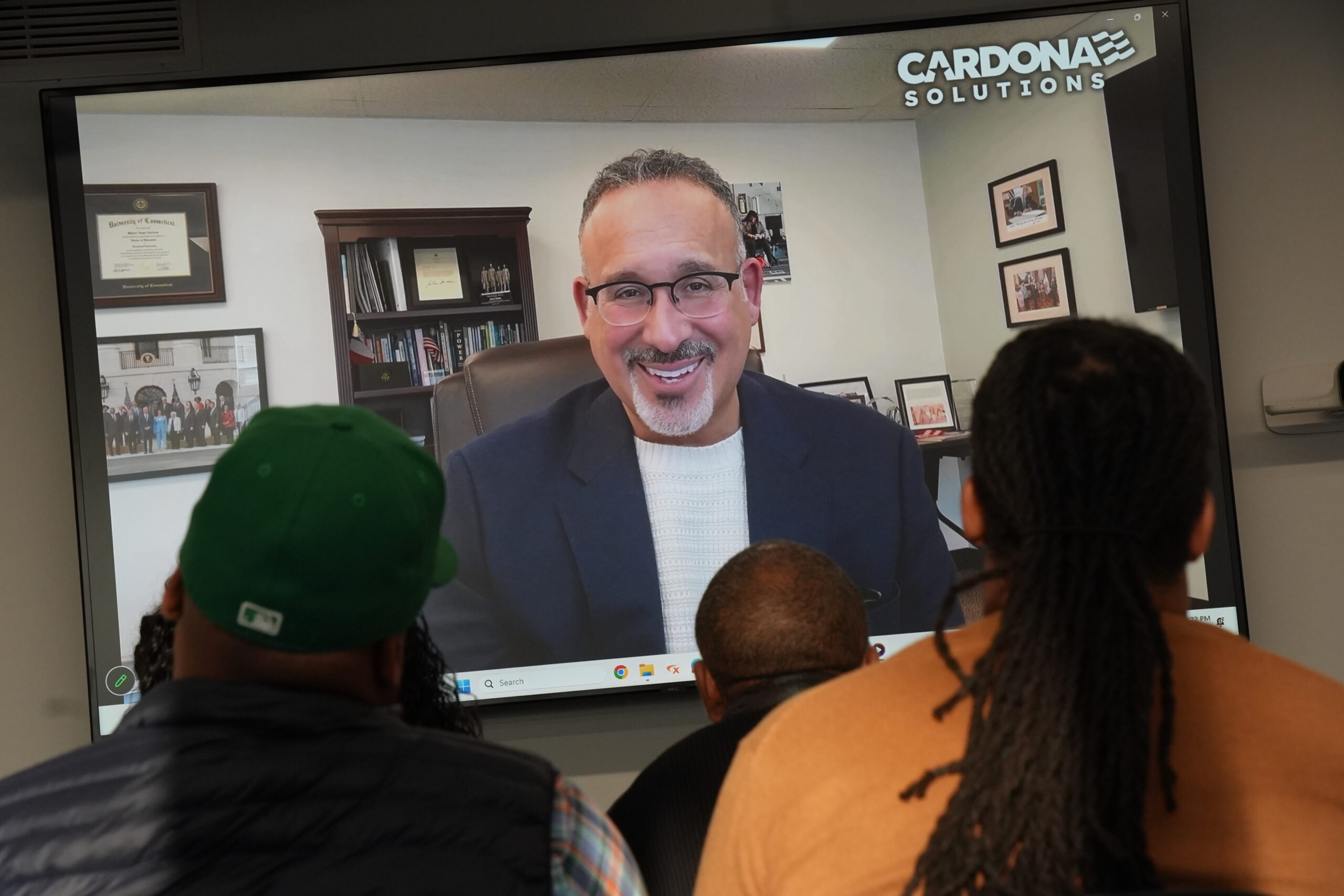
Former U.S. Secretary of Education Dr. Miguel Cardona (1998) congratulated the honorees via video.
Dr. Miguel Cardona sends congratulations via video.
Our Partner
The scholarship program is administered by the Community Foundation of Greater New Britain, “Where Good Begins” in Berlin, New Britain, Plainville and Southington. The Foundation works to inspire philanthropy, manage permanent charitable assets effectively, and partner to address key community issues through strategic leadership.
What is a dual-language classroom? How does it help English speakers as well as English learners? How can teachers establish a strong bilingual classroom culture?
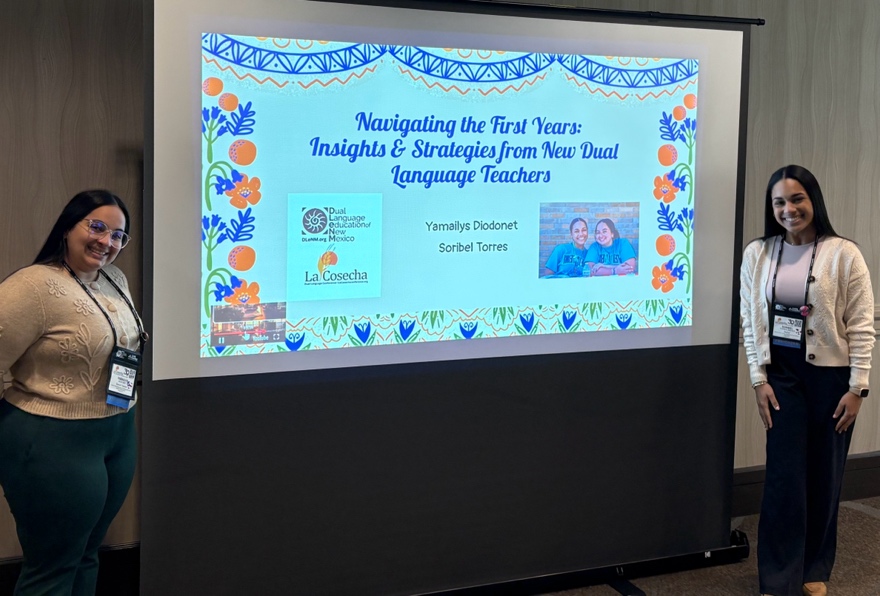
Alma Exley Scholar Soribel Torres-Jiménez answered these questions and many more at a dual-language educational conference in Albuquerque, New Mexico.
Ms. Torres-Jiménez, whom we honored in 2023, presented at the conference with her teaching partner, Yamailys Diodonet. They share a fourth-grade classroom at Roberto Clemente International Dual-Language School in Waterbury, Connecticut.
Yamailys Diodonet, left, and Soribel Torres-Jiménez presenting at Dual-Language Conference.
The annual La Cosecha Dual-Language Conference brings together bilingual and dual-language educators, researchers, and advocates from across the country. The conference is sponsored by Dual Language Education of New Mexico (DLeNM), which promotes bilingualism, biliteracy, and educational equity. “La Cosecha” means “the harvest” in Spanish, symbolizing the sharing of collective knowledge, experiences, and best practices to strengthen dual language education.
Said Ms. Torres-Jiménez, “Our presentation focused on our experiences as new dual-language teachers. We shared the lessons we have learned while building an effective and equitable bilingual program at our school.” They teach in a fourth-grade, dual-language classroom at Roberto Clemente International Dual Language School in Waterbury, Connecticut.
Their presentation covered:
Establishing a strong bilingual classroom culture,
Affirming students’ identities and home languages,
Implementing effective biliteracy strategies in a 50/50 model,
Collaborating successfully as co-teachers, and
Supporting students academically in both English and Spanish.
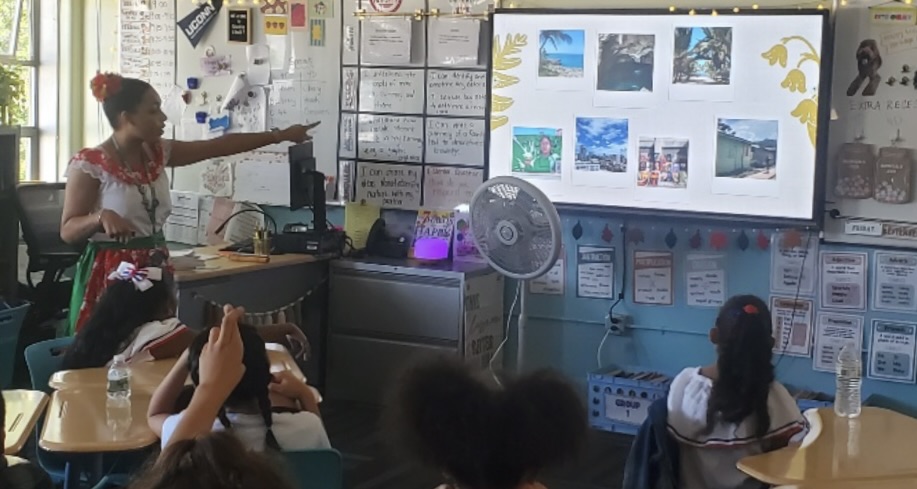
How do the teachers cooperate in a dual-language classroom? They follow a 50/50 dual-language model. Students receive half of their instruction in English and half in Spanish. Ms. Diodonet teaches the Spanish-language component. Ms. Torres-Jiménez, who also happens to be bilingual in Spanish and English, teaches the English-language component.
Yamailys Diodonet, left, and Soribel Torres-Jiménez dressed in traditional Latin American clothing during Family Roots Day at their school (as their school’s late namesake looks on).
Ensuring Academic Growth
“Yamailys and I work closely together to align our instruction, support our students’ academic growth, and ensure consistency across both languages,” Ms.Torres-Jiménez said. “This model allows students to develop strong literacy skills in both English and Spanish while valuing their cultural and linguistic identities.
“Presenting at La Cosecha allowed us to reflect on our teaching practices while learning from experienced educators from across the nation. We gained new insights into biliteracy development, culturally sustaining pedagogy, and program implementation.”
Soribel Torres-Jiménez teaching a lesson in her fourth-grade classroom.
Increasing Student Engagement
“Our students are benefiting because we brought effective strategies back to our classroom, strengthening instruction in both languages. The conference reaffirmed the importance of honoring students’ linguistic and cultural identities. This increases student engagement, confidence, and academic success.”
Ms. Torres-Jiménez is a graduate of Career Academy, a public high school in Waterbury, and the University of Connecticut. She has a Bachelor of Science degree from UConn with a major in elementary education and a concentration in mathematics. She also has a Master of Science degree from UConn in Curriculum and Instruction.