News

News about the program and our honorees

Cherokee Teacher Gains National Notice as Novelist

Annette Bird Saunooke Clapsaddle’s novel came out in September, and it’s already in its second printing.

Her book, Even as We Breathe, has received rave reviews. Publishers Weekly called it “a lush debut, and “an astonishing addition to World War II and Native American literature.”

Since her novel came out, she has been doing virtual readings – at least three a week — at bookstores in New York and across the country. And she was interviewed recently by National Public Radio correspondent Neda Ulaby at her home in the mountains of western North Carolina. Click here to listen to the interview.

Annette Bird Saunooke Clapsaddle

Honored While at Yale

We honored Ms. Clapsaddle with a scholarship in 2003 when she was an undergraduate at Yale. She earned a master’s degree at William & Mary and then returned to her hometown to work for her tribe, first as assistant to the principal chief and later as executive director of the Cherokee Preservation Foundation. She has taught English and Cherokee Studies for 10 years at Swain County High School, whose student population is 30 percent Native American.

She lives in Cherokee, N.C., the main town within the Qualla Boundary, home to the Eastern Band of Cherokee Indians, to which she belongs. The Eastern Band was formed by the Cherokees who escaped being displaced by the Indian Removal Act of 1830. When the federal government forced the Cherokees off their land and drove them west in what became known as the Trail of Tears, some hid in the mountains and remained. Later they reclaimed some of their land and reconstituted themselves as the Eastern Band of Cherokee Indians.

“My Cherokee ancestors have been here, we would say, since the beginning of time,” she told NPR. “Other people would say over ten thousand years.”

A World War II Mystery

The novel is a mystery set at an upscale resort in nearby Asheville during World War II. The resort served as an internment camp for valuable prisoners of war, such as diplomats and their families. The main character is a teenage boy named Cowney, a Cherokee who is accused in the disappearance of a diplomat’s daughter. While Cowney tries to prove his innocence, he also attempts to unravel his complicated family history.

You can order the book here.

The Impact on Her Students

In writing her novel, Ms. Clapsaddle was determined to create characters her students might know in real life.

“For me, that’s what I set out to do, is give my students a story,” she told NPR. One of her students reported he never thought he’d see so much of himself in a character as he did with Cowney. She was deeply moved when he sent her text saying, “People just don’t write about people like us.”

That review is her favorite.

But here’s one of my own. Having just finished the book, I would say that it is more of a love story than a mystery. It’s a compelling love story that ends with an intense emotional impact. The story touched me in a personal way. I think this was not only because of the compelling characters and their fate, but also because of the author’s deeply felt connection with the locale of the story in the ancestral homeland of the Cherokees.

Hearty congratulations, Annette.

  • Woody Exley

New Britain Teacher Expanding the Teacher Pipeline

Sandy Fraioli is taking an ambitious, long-term approach to increasing diversity in the teacher corps. She is starting in high school.


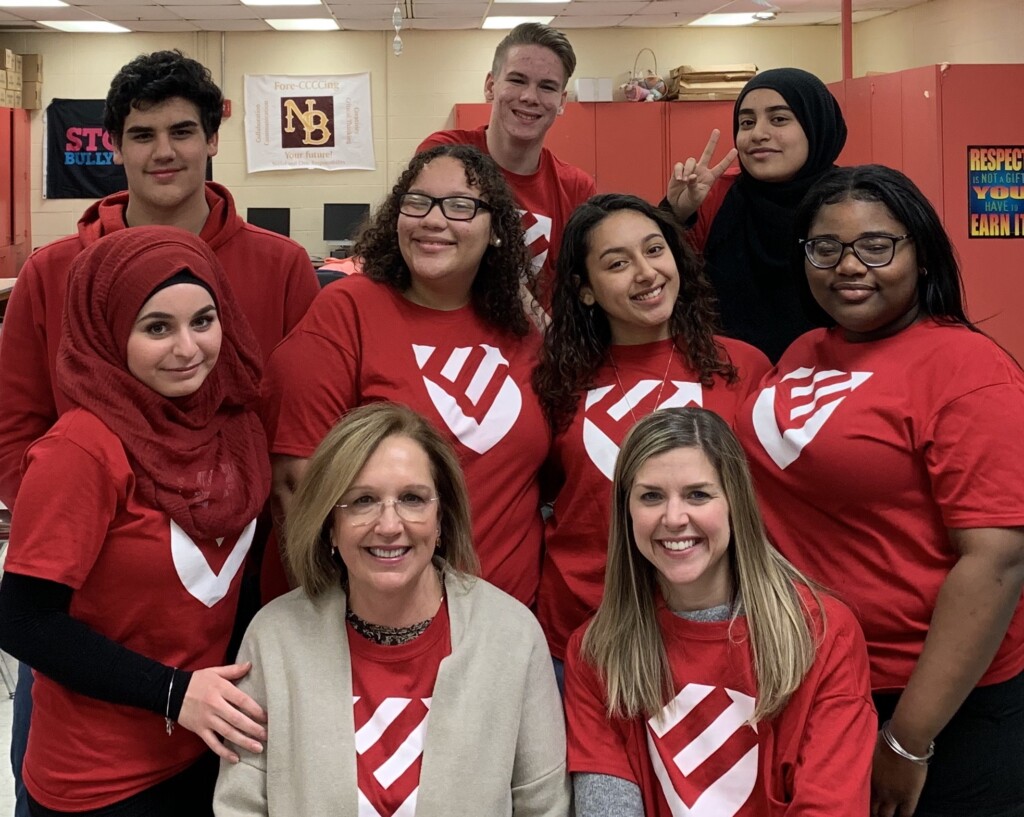
In a pre-Covid-19 photo, Sandy Fraioli, front left, with Colleen Moffett-Mals, who is teaching the Rising Educators course, and their students, front row from left, Shaza Oufi, Lizmarie Maldonado, Deseriah Castillo and Romona Hall, and back row from left, Evan Vinas, Ethan Roy and Maram Aljahmi.

For seven years Ms. Fraioli has led a program to encourage students at New Britain High School – particularly students of color — to pursue careers in teaching. Since then, students from NBHS have enrolled in teacher-preparation programs at Central, Eastern, Southern Connecticut State Universities, University of Saint Joseph, University of Hartford, UConn and Arizona State. And some have graduated and have become teachers.

Sandy Fraioli is Lead Teacher, Family and Consumer Sciences, at NBHS and Teacher Leader in Residence at the Connecticut State Department of Education.

Expanding Into Eight More Districts

Three years ago Ms. Fraioli established a partnership with Educators Rising, a national organization that provides a curriculum of courses to motivate high school students and help them to prepare for careers in education.

This semester, the Connecticut State Department of Education is launching EdRising initiatives in eight additional school districts, Danbury, Hamden, Hartford, Meriden, New Haven, New London, Stamford, Waterbury and Windsor. Ms. Fraioli hopes to have the same success in these districts that she has achieved in New Britain.

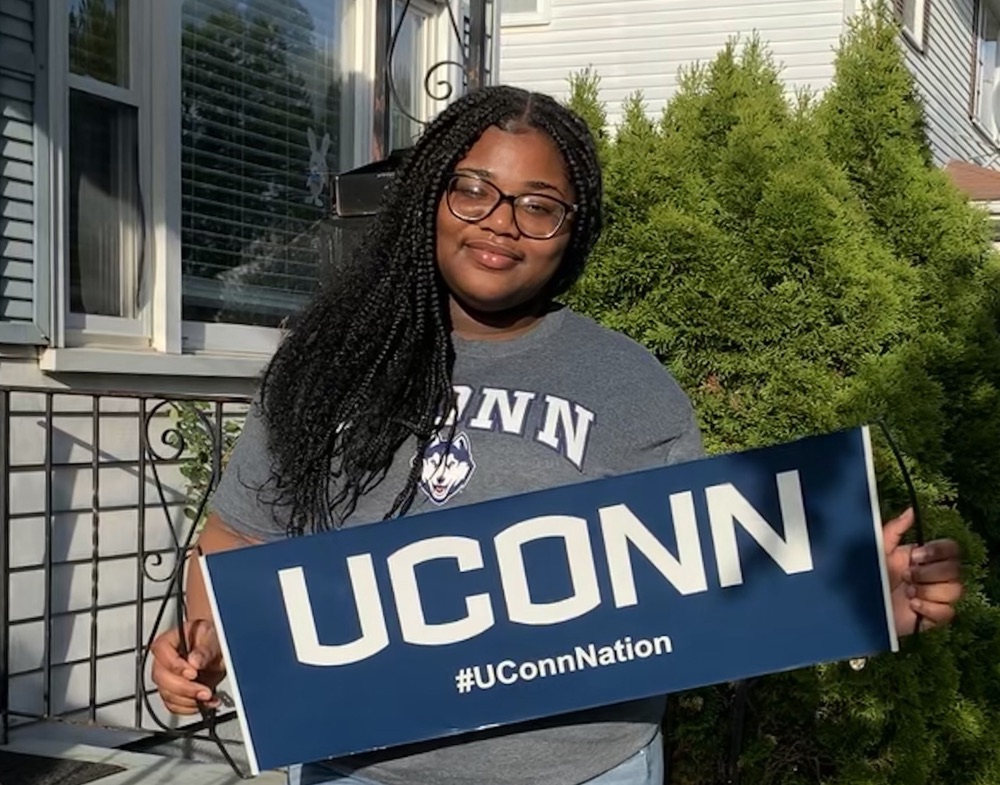
Ramona Hall, who took the course at NBHS, has been admitted to UConn, where she plans to enroll in the Neag School of Education.

“The Educators Rising course definitely helped me to decide what I want to do,” she said. “I had so many good experiences.” As part of the class, she volunteered at elementary and pre-school programs in New Britain. She also did a lot of reading and viewed TED talks about multicultural education.

Ramona Hall, a graduate of New Britain High School, has begun at UConn.

“We learned about the need to be aware of different kids’ situations and how to adapt to teaching in different environments,” she said. “We learned so much about teaching in a diverse community.

“Definitely take the class,” is her advice to other high school students. “It’s so worth it. I’m so happy I took it. The focus on actual teaching was really valuable.”

Dr. Shuana Tucker

Dr. Shuana Tucker, Chief Talent Officer, at the Connecticut State Department of Education, introduced Ms. Fraioli to Educators Rising three years ago when she learned about her efforts to interest students in teaching careers.

“We are pleased to partner with the National EdRising/Phi Delta Kappa organization and the Buck Foundation to implement a proven grow-your-own model to diversify our educator pipeline here in Connecticut,” she said.

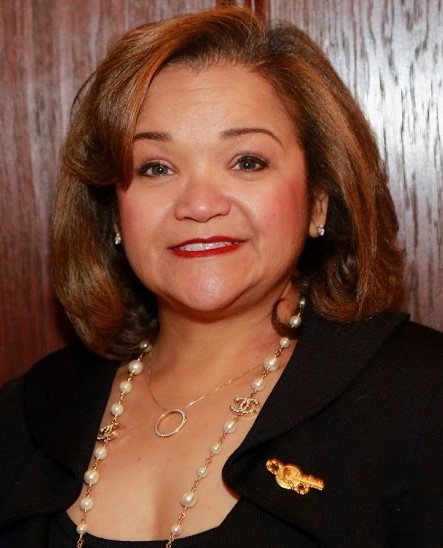
Dr. Violet Jiménez Sims

Kudos From New Britain Board Member

Dr. Violet Jiménez Sims, an Alma Exley Scholar who serves on the New Britain Board of Education, is excited by the way the program has grown from the seed she planted a decade ago.

Dr. Sims initiated and taught the Teacher Cadet course from 2010 to 2012 when she was a teacher at New Britain High School. Sandy Fraioli took over the program in 2013 and nurtured its growth over the pasts seven years. This year Dr. Sims joined the UConn faculty as associate director of teacher preparation at the Neag School.

“I am excited to see the program’s growth and evolution, and the continued support it has received,” said Dr. Sims. “My priorities as a member of the New Britain Board of Education (BOE) remain what they were when I was a teacher in the district — ensuring equity and access for all of our students.

“The EdRising program not only provides the scaffolding for diverse students to become interested in and be able to access teacher education programs, but it also provides a pipeline for bringing graduates back into our community and school system.

Graduate Teaching in New Britain

“In fact, those results are already evident,” she said. “I still keep in touch with several alumni of the first cohort I taught nearly 10 years ago. One is now an elementary school teacher in the district! I look forward to seeing more graduates who participate in this program noted on our BOE personnel reports as new hires.”

At a time when only eight percent of Connecticut public school teachers are persons of color, educators have tried a variety of efforts to achieve greater diversity at the front of the classroom. Many have recognized that efforts to recruit more teachers of color must start early. Waiting until students are in college may be too late.

Moving Into Middle School

“We also had a club at the middle school this year,” Ms. Fraioli said. “Those students are starting high school knowing they want to be teachers. The younger we start the better.

“Our students need teachers who are reflective of the population they’re working with,” she said. “Diversifying our pool of teachers is essential for all ethnicities.

“The earlier we begin planting the seeds in our students that they have the knowledge, confidence and skills to become a teacher, the more apt that they will be to pursue a career in teaching. This has to start now!”

Jessica Raugitinane Meets the Challenge of Teaching Remotely

Covid-19 has turned teaching upside down.

But Jessica Raugitinane, who is teaching her fourth-graders remotely, has found a way to create a familiar, positive classroom culture despite the distance.

We honored Ms. Raugitinane in 2012 when she was an undergraduate at UConn’s Neag School of Education. She earned her master’s degree in 2014 and has been teaching dual-language English and social studies at Mount Vernon Community School in Alexandria, Va., for several years.

She also trains teachers in her school district in strategies from Project GLAD® (Guided Language Acquisition Design), which promotes English language learning and high academic achievement in a positive classroom culture.

Converting to Remote Learning

Educators have recognized that implementing remote learning requires much more than just placing a computer in front of the teacher.

When the pandemic forced the Alexandria schools to convert to remote learning, Ms. Raugitinane realized she would have to make significant changes. She was determined to ensure that her students would still receive the education they need and deserve. She committed to continue using her successful best practices while adapting them to the virtual world.

“When my school shut down, I had to learn how to command an in-person job through a computer screen,” she said. “Fortunately, my school helped me discover the RULER approach developed at Yale and Larry Ferlazzo’s Seven Tips for Remote Teaching.

“Combined, these techniques solidified my decision to focus on the social emotional needs of my students before diving into academic content. However, applying Project GLAD® strategies enabled me to address my students’ social emotional needs while continuing to develop their language learning.”

Quite a bit of preparation was required. Ms. Raugitinane completed the RULER online training in four hours, then devoted her spring break (10 eight-hour days) to creating the 10-lesson mini-unit plan using the interactive Nearpod website. This included creating the lessons on Google Slides first and then making them interactive with Nearpod.

“I was motivated to invest the time in creating this 10-lesson mini-unit plan so that I would have a reusable template for plugging in future content,” she said. “Later I plugged in the Social Studies content to teach about Jim Crow Laws and segregation. That 10-lesson mini unit plan took me four days, compared to the original 10 days for the first unit plan.

“I wanted to make sure I was applying my knowledge of Project GLAD® strategies and Nearpod to make an interactive, language-rich academic environment, while creating a routine for myself and my students.”

Sharing Her Experience

She recently shared her experience in distance learning in an article in Soleado, a publication of Dual Language Education of New Mexico.

The article provides a wealth of techniques and strategies that will be useful to teachers intent on meeting the needs of their students during this stressful and demanding time. Read the full article.

As she wrote in the article:

“With the global pandemic taking us all on an emotional roller coaster, helping my students navigate their own emotions within this new quarantined world became paramount.

“Fortunately, at the start of the closure, I learned about RULER, an evidence-based, systemic approach to social-emotional learning developed at the Yale Center for Emotional Intelligence (www.ycei.org/ruler).

“RULER stands for the five skills of emotional intelligence: recognizing, understanding, labeling, expressing and regulating. The RULER online training taught the importance of developing students’ emotional literacy. Essentially, providing students with the language of emotions enables them to better identify and express their feelings.

“I also learned the value of asking students the simple question: ‘How are you feeling?’ before beginning a lesson as a way to regulate emotion and encourage more on-task behavior. Undoubtedly, helping students understand and express their emotions during these uncertain times became the heart of my remote teaching.”

Additional Lessons

Among the other lessons she learned in preparing to teach remotely:

  • Establishing an equitable and accessible routine provided much-needed consistency for my students and myself.
  • Three tips from Larry Ferlazzo’s Seven Tips for Remote Teaching are essential: 1) emphasize social-emotional learning; 2) minimize synchronous online meetings: 3) keep things simple.
  • Both RULER and Ferlazzo’s advice prioritize social-emotional connections as a necessary ingredient to academic success, especially during distance learning.
  • Ferlazzo’s advice further encouraged me to deliver learning both synchronously and asynchronously in order to provide equity of access to students. And to keep things simple, I focused on teaching a unit’s main concepts rather than attempting to cover a myriad of information.

Congratulations to Jessica Raugitinane for rising to the challenge of remote learning, cultivating new knowledge and skills, and sharing her learnings with fellow professionals who are facing the same daunting challenge.

  • Woody Exley