Author Archives: Woody

Violet Jimenez Sims Urges Bilingual Reform

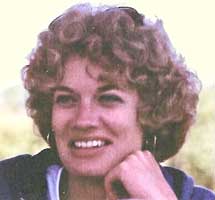
Many of us are troubled by the realization that Connecticut has the nation’s largest educational achievement gap between English-language learners and students fluent in English. While many wring their hands and bemoan this sad fact, Violet Jiménez Sims is trying to do something about it.

Ms. Sims, whom we honored in 2008, has become an advocate for reform of the bilingual education system in Connecticut’s public schools. She served on a panel of educators who addressed this issue at a conference at Central Connecticut State University Feb 27-28. Earlier in February, she spoke at a forum on the topic at the New Britain Public Library.

Most recently, she posted an op-ed essay advocating reform in bilingual education in the CT Mirror online publication. We are reprinting it here.

Ms. Sims taught Spanish and English for Speakers of other Languages (ESL) for several years at New Britain High School and now is a bilingual educator and instructional coach at Manchester High School. She holds bachelor’s and master’s degrees and a Certificate of Advanced Graduate Studies from the University of Connecticut and is pursuing her doctorate at the University of Bridgeport.

Congratulations to Violet for working to make a difference. She is one of many Alma Exley Scholars who are having a positive impact in a variety of ways. Following is her op-ed from the CT Mirror. – Woody Exley

By Violet Jiménez Sims

Central Connecticut State University has taken the lead in speaking up for a marginalized sector of our population with the recent conference titled “Dos Días para Transforming Bilingual Education in Connecticut.”

20150314_004036~2

This topic is especially important to the children, parents, and educators across Connecticut, as a recent Hartford Courant article pointed out the shameful fact that our state leads the nation with the largest achievement gap between English Language Learners (ELL) and their peers who are English fluent.  According to the article, the gap in Connecticut is 54 percent larger than the national average. Why is this happening? Several reasons.

First, Connecticut state statute limits bilingual education (defined as a program where students receive academic support in their native language) to a maximum of 30 months, even though well-established research shows that students need a minimum of five years to attain grade level proficiency in a second language.

Second, Connecticut does not fully embrace dual language models, the best way for children to reach fluency bilingually. There are only six dual-language schools in the entire state and cities such as New Britain have closed down these research-based programs that are thriving internationally and throughout the rest of the country.

For example, New York currently has hundreds of dual language schools and is expanding by as many as 40 new dual language schools this year. These models are superior because they allow both ELLs and monolingual English speakers to become fully bilingual.

Third, bilingual education in Connecticut is not equitable.   For example, affluent suburban communities, such as Avon and West Hartford, offer world language instruction kindergarten through high school.  Meanwhile, most ELLs attending Connecticut’s urban districts are at risk of losing their native language as their schools focus on pushing ELLs to acquire English with methods that sacrifice their first language, but do not lead to grade level proficiency; a process known in language acquisition theory as fossilization.  Therefore, suburban children have the privilege of becoming bilingual, while our urban students lose their home languages and half-learn English.

Local districts in Connecticut have wasted millions of taxpayer dollars on “get proficient quick” schemes, like Kevin Clark’s English Language Development (ELD) program, which have failed elsewhere and have been challenged by the U.S. Office of Civil Rights.

Proponents of such programs claim that their data shows sharp improvements in English proficiency, but these results are skewed as they use assessments created by the same people that sell the programs and teachers are trained to “teach to the test.” The validity of these programs is highly undermined by assumptions and a lack of alignment to empirical research, or strong theory. Additionally, ELLs are segregated from their English-fluent peers for several hours a day, where they miss the other important academic subjects like Social Studies and Science. These corrupt practices must stop.

Properly educating our youth is beneficial to the entire population. Thank you to CCSU for taking the lead in Connecticut by hosting a much-needed conversation on how to change bilingual education in our state. Over 200 professionals participated. Our children and society depend on this continued valor.

Campus Leader Is Newest Alma Exley Scholar

IMG_3103

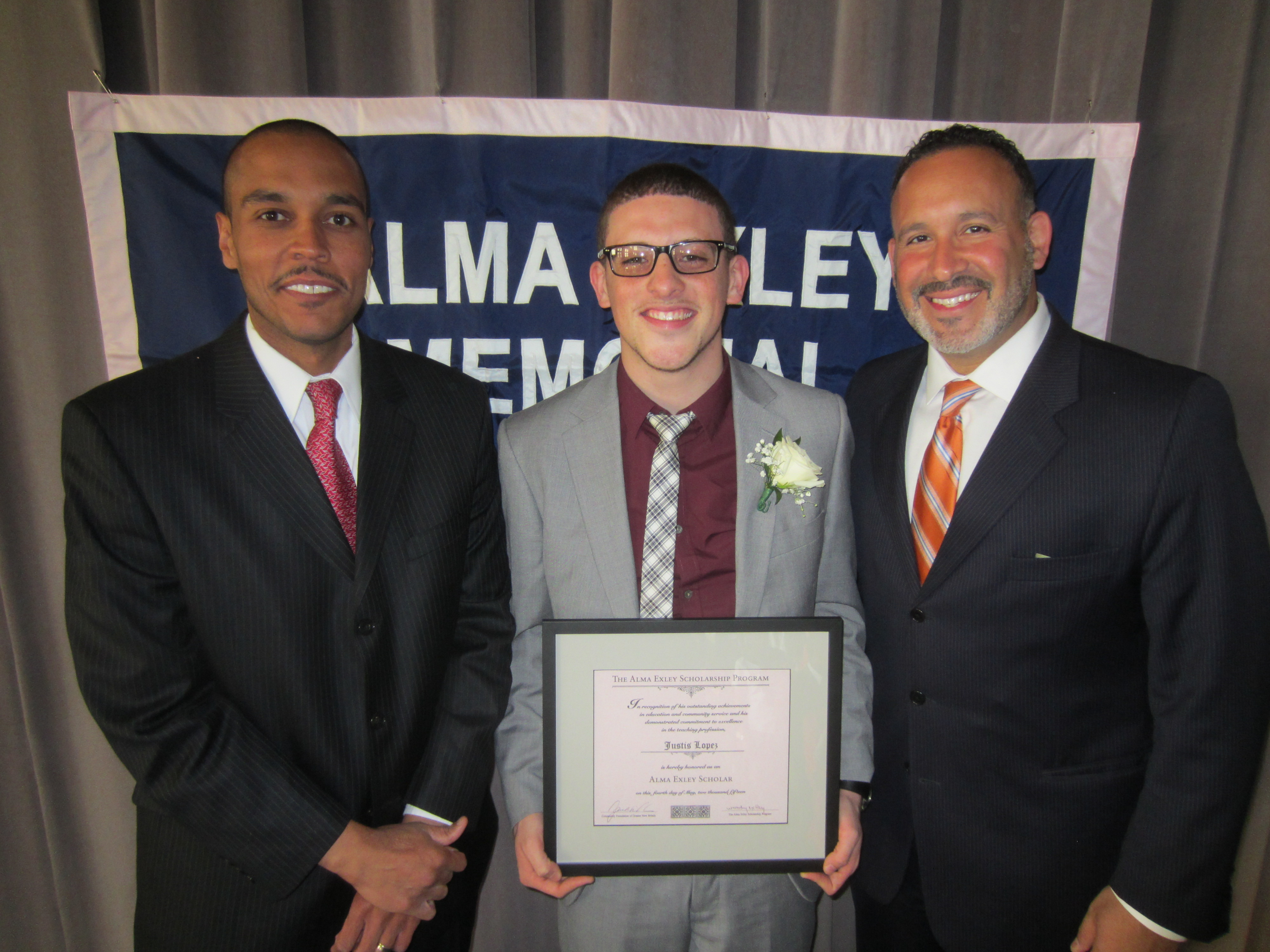
Justis Lopez of Manchester, a student at the University of Connecticut, has been chosen as the Alma Exley Scholar for 2015. Educators, friends and supporters of the program honored him at a reception. on Monday, May 4, at the Elmwood Community Center in West Hartford.

Welcoming Justis into the Alma Exley Scholarship Family were previous recipients Desi Nesith, principal of Metacomet School, Bloomfield, left in photo above, and Dr. Miguel Cardona, performance evaluation specialist in the Meriden Schools, at right.

Justis, a graduate of Manchester High School, is a student in the five-year Integrated Bachelor’s and Master’s Program in the Neag School of Education at UConn. He received a B.S. in Education with a major in history in May 2014 and is scheduled to receive an M.A. in Education on May 9, 2015.

He has an outstanding record of academic achievement, public service and campus leadership. As he says, “Nothing great is achieved without enthusiasm.” And with his enthusiasm and ability, he has the potential to do great things as an educator.

His flair for leadership became apparent early in his UConn career. He received the Emerging Leader Student Life Award as a freshman. This recognized his leadership in programs to orient and support new students.

He has been active in a summer program sponsored by Student Support Services to assist low-income, minority students who are the first in their families to attend college.

Justis has lent his considerable talents to a variety of initiatives to promote diversity and multicultural understanding at UConn and beyond.

He was one of 14 students chosen to take the lead in fostering an inclusive community at the university. And he has worked in an inter-university initiative with the American Association of Colleges for Teacher Education (AACTE) to broaden the demographic makeup of the teacher workforce.

He has been involved in the K-5 College Bound Program, which brings youngsters to UConn to give them a taste of college life and encourage them to aspire to higher education.

He has been active in other campus organizations such as Bring Awareness to Latino Ethnicities (BALE), the Puerto Rican and Latino Cultural Center, and Leadership in Diversity (LID), intended to “put the lid on the achievement gap.”

During the summer of 2013, he served as an intern at the University of Albany. Working in the Office of Intercultural Student Engagement, he implemented the Brother 2 Brother mentorship program for incoming freshmen. He also built the Gender and Sexuality Resource Center to cultivate an inclusive community for LGBTQ students.

In the summer of 2014, he served as a public policy intern in Washington D.C with the Council For Opportunity In Education. In that position he worked with educational advocacy groups in the U.S. Department of Education in conjunction with the White House and drafted proposals for educational programs to be considered by Congress in 2015.

He was a familiar figure at UConn sports events performing as Jonathan the Husky as a sophomore. And he was the UConn Homecoming King in 2014.

He also has made a name for himself as master of ceremonies and DJ for more than 300 social events. Based on this experience, he has established Justis League Entertainment, which provides music and photography for school functions, weddings and business events.

He won a TEDx Student Speaker Award in 2013. He was one of a number of college students participating a program patterned after the well-known TED (Technology, Entertainment, Design) events.

While pursuing a wide variety of extra-curricular activities, Mr. Lopez has achieved a strong academic record and has won praise from the faculty for outstanding performance in his student teaching assignments.

He is a most deserving scholarship recipient, and we are delighted to welcome him to the Alma Exley Scholarship Family.

Connecticut’s High School Educator of the Year

Since we honored Dr. Sibani Sengupta in 2009, she has received a number of honors for excellence, dedication and leadership in education.

The Connecticut Association of Schools has selected her as the High School Level Exemplary Educator of the Year for 2014-2015. She also has received the 2014 Local Hero Award from the Ronald McDonald House Charities of Connecticut and Western Massachusetts. In 2010, the National Association of Biology Teachers presented her with the Outstanding Biology Teacher Award for Connecticut.

Sibani Sengupta_photo (2).tiff
Sibani Sengupta, Ph.D.

Dr. Sengupta is a science teacher and dean of academic affairs at Sacred Heart Academy, Hamden, Conn.

The CAS award recognizes outstanding educators who have had a positive impact on their schools through excellence in education, involvement with students, staff and parents in and out of the classroom, and leadership in their profession. 

The Local Hero Award honors 10 outstanding teachers from Connecticut and Western Massachusetts for their hard work, dedication and commitment to area students.

Dr. Sengupta is the third Alma Exley Scholar to be honored by CAS. In 2010 Desi Nesmith was named the Best First-Year Principal in Connecticut, and in 2012 Dr. Miguel Cardona was chosen as Connecticut’s National Distinguished Principal.

Dr. Sengupta has a Ph.D. from the University of Connecticut and did post-doctoral research at the UConn Health Center. Then she earned her Connecticut teaching credentials through the Alternate Route to Certification.

She left a career as a research scientist to teach science at Sacred Heart Academy in 2003. After serving as chair of the science department for six years, she was named dean of academic affairs in 2014. She continues to teach advanced-placement biology, human gene discovery and microbiology.

In nominating Dr. Sengupta for the CAS award, Sr. Mary Jane Paolella said she is known for creative, imaginative lessons that are extremely successful and engaging.

Sr. Paolella said that freshmen appreciate her biology classes so much that 75 percent of them sign up for a science elective (genetics, microbiology or gene discovery) in addition to chemistry, hoping that she will be teaching one of those courses the following year.

As an example of Dr. Sengupta’s excellence in teaching, Sacred Heart Dean of Students David Alexandro noted that her students have designed and standardized a high school adaptation of a procedure called RNAi.  Her article, “Bringing RNA Interference (RNAi) into the High School Classroom,” was published in the “How To Do It” section of the November/December 2013 issue of The American Biology Teacher magazine.

“Excellent teaching requires more than just teaching the subject,” Dr. Sengupta said. “It is essential to constantly motivate students, encouraging them to develop a zest and passion for the subject, along with their unique, analytical approach towards learning.”

Dr. Sengupta sets an example for her students by her love for life-long learning. “Over the past couple of years,” she said, “I have come to fully appreciate the true meaning of Tyron Edwards’s famous quote, ‘If you would thoroughly know anything, teach it to others.’”

Hearty congratulations from all of us at the Alma Exley Scholarship Program to Dr. Sengupta for this well-deserved recognition.

The Connecticut Association of Schools (CAS) is a private, non‐profit organization whose purpose is to improve the learning of every student in Connecticut by contributing to the improvement of elementary and secondary education. CAS works to serve the collective interests and needs of Connecticut schools by providing leadership and professional development services to promote excellence in the education of all students.