Author Archives: Woody

Justis Lopez Is New England’s ‘Rising Star’

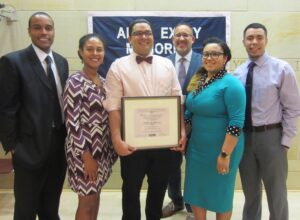
Everyone who knows Justis Lopez that he is a rising star. But now he can officially claim that title. He has received the annual Rising Star Award from the New England Educational Opportunity Association.

Mr. Lopez, whom we honored in 2015, received the award at the organization’s annual conference recently in Stowe, Vermont.

NEOA is an organization of educators who work to ensure equal educational opportunities in higher education for low-income individuals, first-generation college students, and students with disabilities.

The Rising Star Award recognizes emerging professionals who are former participants in NEOA educational opportunity programs. Mr. Lopez’s involvement with NEOA began at the University of Connecticut, where he was active with the Student Support Services program.

The SSS program opened a number of opportunities for him during his undergraduate years. He won an internship in Washington, D.C., with the NEOA-affiliated Council for Opportunity in Education, which enabled him to meet President Barack Obama. He served as a peer leader to a group of SSS undergraduate students studying in London, England. And he served as a residential coordinator in the SSS Pre-Collegiate Summer Program.

Reflecting on the impact that SSS has had on his life and career, Mr. Lopez has this to say:

“Never has any program I have been a part of shifted the trajectory of my life as much as SSS has. I have met some of my best friends and learned some of my largest life lessons that the classroom never could have taught me in that program, and I am forever grateful.”

Now finishing his third year as a high-school social studies teacher, Mr. Lopez has been honored as “an emerging leader who is striving for the highest levels of personal and professional achievement,” in the words of the NEOA. Rising Star honorees are recognized for exceling in their chosen fields, devoting time and energy to their communities in a meaningful way, and serving as role models for other low-income, first-generation, college-bound students and students with disabilities.

Mr. Lopez began his teaching career at Manchester High School. Since September 2017, he has been teaching at Urban Assembly School of Applied Math and Science, a public school in The Bronx, N.Y.

Congratulations to Justis Lopez on this much-deserved recognition by an organization of educators from across New England. Our selection committee knew he was destined for greatness, and I’m delighted that he is gaining recognition in the wider education community.

— Woody Exley

More Black Teachers Needed To Remedy Achievement Gap

The achievement gap between white students and students of color has been vexing Connecticut educators for some time.

Many educators are working hard to correct this disparity. In fact, our own Dr. Miguel Cardona (1998 Alma Exley Scholar) has led a legislative commission that has addressed the issue and offered recommendations. He has also worked with the State Department of Education to help develop a statewide approach to the achievement gap. But the problem persists.

Disparities Facing Black and White Students

Now Connecticut Voices for Children, a New Haven-based research and advocacy group, has published a report that describes in detail the disparities that face black and white students as they go to school each day. The report decries the disparate educational outcomes and prescribes a number of remedies.

One of the key findings of the report is especially interesting to the Alma Exley Scholarship family. The report declares, “Access to teachers of the same race differs dramatically, with black students much less likely to have teachers of their own ethnicity.”

According to the report, only 3.5 percent of teachers in the state are black, while black students constitute 13 percent of the student population. (The report just focuses on the disparities between black and non-Hispanic white students. It does not refer to other students of color.)

Black Students Have Greater Success With Black Teachers

The report concludes that the dearth of black teachers matters because black students achieve higher levels of success when they have had a black teacher.1 As the report says, “By bolstering student confidence and alleviating feelings of marginalization, black teachers can act as a protective factor against negative experiences like punitive discipline policies or racist comments.”

The impact of black teachers is said to be highest for black male students from low-income households.2 In one study, researchers found that black male students who had a black teacher in elementary school were up to 39 percent less likely to drop out of high school.3

Efforts Under Way at State Department of Education

Connecticut Voices for Children recommends increasing the number of black teachers and expanding support for minority teachers. The organization applauds the State Department of Education’s Talent Development Office and the Minority Teacher Recruitment Policy Oversight Council, which have been working to increase the number of teachers of color in the state.

Given the positive correlation between having a black teacher and the success of black students, the hiring, training, and support of teachers of color should be a priority. Unfortunately, the 2018 budget of the Talent Development Office has been cut by 89 percent. Hence, Voices for Children calls for the restoration of the office’s funding.

Other Factors in Divergent Experiences of Black and White Students

As the report confirms, the dearth of black teachers is just one of the factors in the vastly different school experiences encountered by black and white students. And these factors result in vastly different outcomes.

For example:

  • Suspension ratesare four times higher for black than white students.
  • Chronic absenteeism ratesare two and a half times higher for black students.
  • Access to advanced classes is significantly more limited, with black students constituting only 7 percent of students enrolled in gifted and talented programs.

Initiatives Recommended

In addition to urging the hiring and supporting of more black teachers, the report recommends a number of other initiatives. These include:

  • Expanding data sharing on school discipline and attendance to identify chronically absent students;
  • Improving anti-bias training for school personnel;
  • Increasing school funding to districts with high minority populations.

Read the full report.

Connecticut Voices for Children’s mission is to promote the wellbeing of all of Connecticut’s children and families by identifying and advocating for strategic public investments and wise public policies. Connecticut Voices advances its mission through high-quality research and analysis, policy development, strategic communications, and establishment of a sustainable and powerful voice for children.

1The Albert Shanker Institute, 2015, The State of Teacher Diversity in American Education.

2 Seth Gershenson, Cassandra Hart, M. D., Constance A. Lindsay, and Nicolas W. Papageorge. The Long-Run Impacts of Same-Race Teachers 3 Ibid.

Teachers Of Color Vs. The Achievement Gap

Over the past 22 years, our program has been committed to the idea that students of color benefit from having teachers with whom they can identify. During this period, studies have emerged that have supported this idea.

The most recent to come to my attention was an academic study published by the Institute of Labor Economics. WSHU-FM, a public radio station in Southern Connecticut, recently aired a report on the study.

The study, by professors at American University, University of California-Davis, and Johns Hopkins University, examined the long-term impact of teachers of color on their demographic counterparts.

The professors acknowledged findings that black primary-school students with a same-race teacher perform better on standardized tests, but they went further. They concluded that a black male student with a black teacher in the third, fourth, or fifth grade is much less likely to drop out of high school, particularly among the most economically disadvantaged black males.

In addition, the study found, exposure to at least one black teacher in grades 3-5 also increases the likelihood that low-income students of both sexes will aspire to attend a four-year college.

This makes it all the more important to recruit and retain more teachers of color in Connecticut’s schools. Read the WSHU-FM report here.

  • Woody Exley