Educators and supporters of the Alma Exley Scholarship Program honored Jessica Raugitinane at a reception at the Elmwood Community Center in West Hartford on April 26, 2012.
Ms. Raugitinane became the 23rd recipient honored by the program since 1996. She was completing her junior year in the five-year Integrated Bachelor’s and Master’s Program at the University of Connecticut. She is pursuing majors in Elementary Education, English and Spanish, with a minor in Latino Studies.
Guest speaker at the reception was Desi Nesmith, 2000 recipient of the Alma Exley Scholarship, who serves as principal of Metacomet School in Bloomfield. Introducing Ms. Raugitinane was Violet Jiménez Sims, a Spanish teacher at New Britain High School who was honored by the scholarship program in 2008.
Two other previous recipients also attended to congratulate Ms. Raugitinane. They were Dr. Santosha Oliver, an administrator in the East Hartford Public Schools, and Sacha Kelly, a mathematics teacher at the Global Experience Magnet School in Bloomfield.
Woody Exley, who hosted the reception, acknowledged the support of hundreds of individuals who have contributed to the scholarship program over the past 16 years.
Ms. Raugitinane has an exemplary record of public service in education. Most recently, she has volunteered in the America Reads program at Kinsella Magnet School in Hartford and in the Family Literacy program in Storrs.
Serving with International Student Volunteers in the summer of 2010, she taught students age 3 to 16 in a one-room school in an impoverished, remote area of the Dominican Republic. Previously, she volunteered as a tutor and teacher’s assistant at schools and community programs in Alexandria, Va.; Washington, D.C.; and Windham, Putnam and Willimantic, Conn.
A consistent Dean’s List student at UConn, she has been elected to the Alpha Lambda Delta National Honor Society.
Violet Jiménez Sims, recipient from 2008, writes about her experience at New Britain High School, where she teaches Spanish. Ms. Jimenez Sims earned bachelor’s and master’s degrees from the University of Connecticut and is a graduate of Connecticut’s Alternate Route to Certification. Posted January 20, 2012.
As I walk down the hall of an urban high school, I hear the N-word being thrown around more frequently than “please,” “thank you,” or even “hello.” Somehow I don’t cease to be amazed when even a white kid walks down the hall, passes one of the “cool” kids, and immediately tries to connect by exclaiming, “What up, my nigga!” I cringe at the sound of this foolishness. The African American students are not offended by this; after all, they are the first ones to run around using it as a show of affection.
This mental slavery that so many of our young people subject themselves to is an absolute disgrace to all the civil rights leaders who fought to eliminate injustice and the open degradation of people of color. The shackles are not physical, but yet their subliminal control is more powerful than a wrought iron ball and chain.
Supposedly, the N-word has changed in meaning. Many claim it is still used with both negative and so-called “positive” intention. The spelling change that is often claimed as significant is simply an ignorant cop-out. Have you even been in an urban environment? Urban vernacular commonly drops “er” endings without words losing their meaning: “motha” “fatha” “sista” “brotha.”
The word “nigger” was used by the “massa” to label slaves with an artificial ignorance that would justify why they traded them like cattle, and physically abused them in a way that would have PETA in an uproar if the same were done to a dog. It defines a lazy person with no self respect, no regard for family, ignorant, stupid, slow moving, who does not speak proper English. Even after so-called “freedom” and emancipation, the KKK used the term to identify those who would be hanged, castrated, or even burned alive.
Sadly, while most Americans can trace their lineage back for centuries and to their countries of origin, it is difficult for many African Americans to trace their lineage past a few generations. Family histories were lost due to the slave trade’s purposeful separation of parents from their children and siblings from each other. As a result, African Americans developed a more inclusive term, one that connects those who shared an unimaginable struggle, and was often heard in the uplifting discourse of civil rights leaders, “brother.”
So, why use what the oppressor developed rather than that of the people who sacrificed in unthinkable ways allowing us to have the opportunities and enjoy the freedoms we have today?
And if you think that history doesn’t apply to you because you’re Puerto Rican or Dominican, you are mistaken. Learn your history, because the slave trade on our precious islands began even before it did on the U.S. mainland, and its effects are still apparent today.
The change would be small, but its effects on camaraderie would be immense. Conveniently, brother and sister also happen to end in an “er” that is often replaced by an “a” in urban vernacular. So, all your favorite raps would still rhyme while you boost your morale by referring to each other with words that foster unity rather than ignorance. The invisible shackles must be broken and replaced by visible embraces. Instead of tripping each other we could actually hold each other up.
The N-word alone is not the problem. Inflated poverty rates, disproportionally low graduation rates, and unemployment rates are bigger problems.
But the frequent use and acceptance of the N-word by our own people is a daily reminder that, although we have overcome many things, many of us have lost sight of how far we have to go.
Saying this word and allowing others to say it is a sign that we have given up, or mistakenly believe the fight for equality is over.
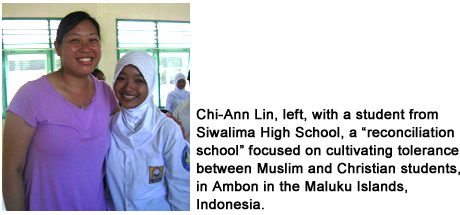
Chi-Ann Lin has brought much more than book learning to her teaching of East Asian Studies at Staples High School in Westport.
Since joining the faculty in 2001, she has traveled extensively across Asia. She has been accepted into study programs that have taken her to Japan, South Korea, China, United Arab Emirates, Turkey and Indonesia. She has soaked up the history and culture of these countries, enriching her classes with knowledge that can be gained only by firsthand experience.
We honored Ms. Lin with an Alma Exley Scholarship in 1999. Since then, I have enjoyed hearing about her travels when we met at our annual receptions and meetings of the selection committee, on which she has served for several years.
But I thought this was a good time to call her and learn more about how her globetrotting has broadened her experience and enriched her classes.
When Ms. Lin began her career in the classroom, she asked to teach East Asian Studies. She thought this would enable her to delve more deeply into this important subject – and also to learn more about her own ethnic background.
Ms. Lin was raised in Alabama and Connecticut by parents who had come from China and Taiwan before meeting in New York City. She attended Newington High School and graduated with honors from the five-year program at the University of Connecticut in 2001.
After taking the position in Westport, she applied to the Fulbright Memorial Fund and was chosen for the program that took her to Japan in 2007 with 200 other American teachers. She spent three weeks in Tokyo and Himeji, learning about Japanese history, politics, education and culture. Returning home, she created a blog for her students. Her extensive photos and commentary stimulated lively discussions in her classroom.
“That’s when I got the travel bug,” she said, explaining that she continued to apply for foreign study programs. During the summer of 2008, Ms. Lin participated in a Yale PIER (Programs in International Educational Resources) Institute focusing on the Silk Road, a major, ancient trade route across China. After attending lectures at Yale, she visited western China and returned home via stops in Dubai, the United Arab Emirates, and Istanbul, Turkey.
The next summer she participated in a two-week Korean Studies Workshop based at Yonsei University in Seoul.
Finally, in the summer of 2010, she spent over a month in Indonesia with a Fulbright Hays Group Project Abroad. This enabled her to visit several islands of the archipelago, and stay at an Islamic boarding school.
“In Japan, I learned about the impact of Confucianism on the culture,” she said. “Traveling to western China and Indonesia opened my eyes to the presence of Islam in Asia.”
Experiences gained in her travels have inspired new ideas for her teaching and new perspectives on history and culture to share with her students.
“As an Asian American, I feel an obligation to offer my students an accurate and meaningful curriculum to help them learn about a region that is sometimes misunderstood,” she said.
“Each year, more Asian American students have enrolled in the East Asian Studies course,” she said. “They want to get a better understanding of their culture and history, and I believe that my travels have helped me to give them a more meaningful learning experience.”
Ms. Lin said that one of the most important lessons she has learned as a teacher is the importance of being a lifelong learner. She hopes to continue exploring the world and sharing her newfound knowledge with her students.
And she urges other teachers to take advantage of the kind of programs that have benefited her. “There are a lot of programs out there,” she said. “They can make a big difference in bringing a fresh approach to the classroom.” Her programs were fully funded by the sponsoring organizations, except for the Indonesia and Silk Road trips, for which she paid part of the cost.
Each of our Alma Exley Scholars is having an impact in a way that is unique to their individual interests and talents. I’m proud of all of them, and I’m glad this website gives me the opportunity to let you know what they are accomplishing in their diverse careers.