News

News about the program and our honorees

Connecticut’s High School Educator of the Year

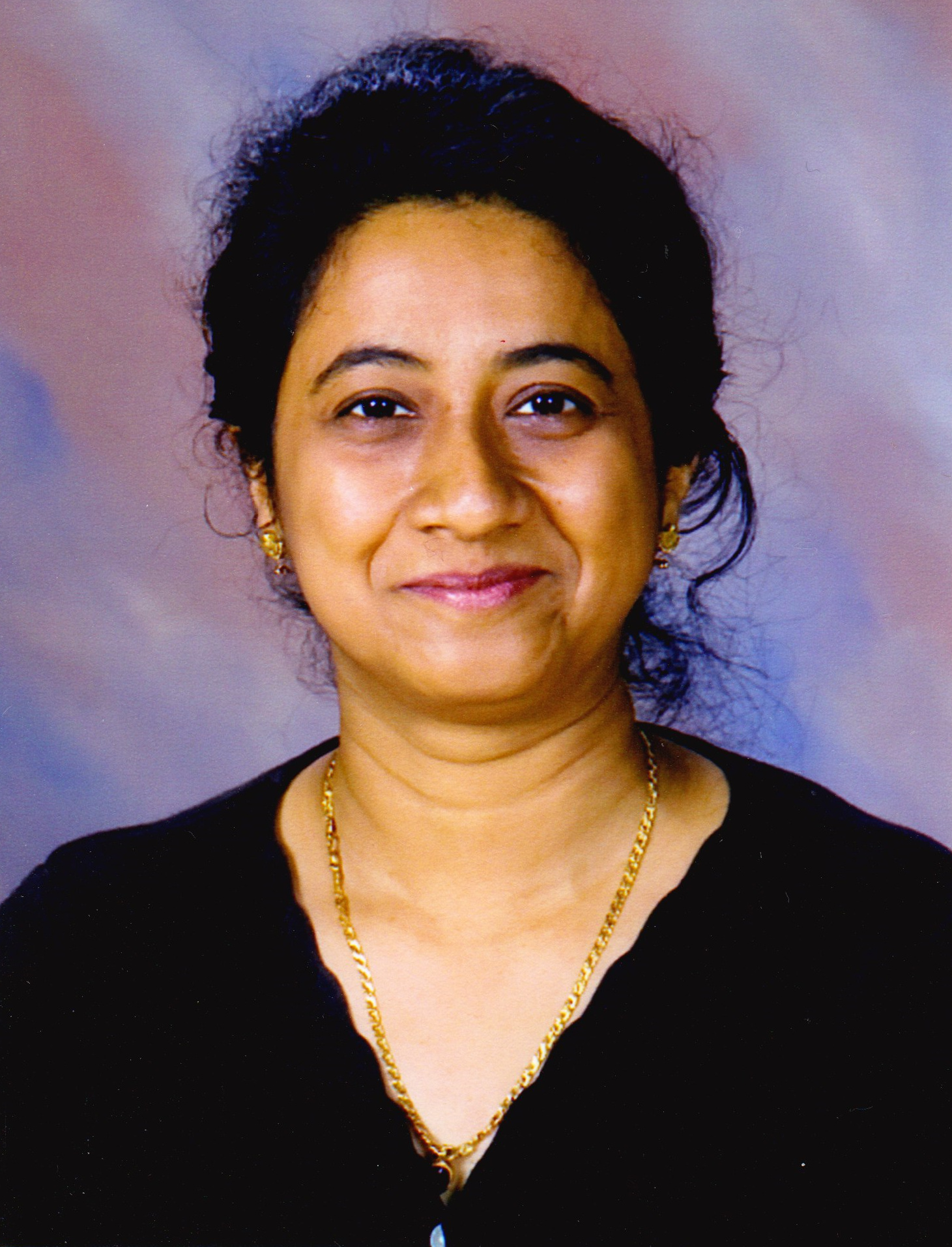
Since we honored Dr. Sibani Sengupta in 2009, she has received a number of honors for excellence, dedication and leadership in education.

The Connecticut Association of Schools has selected her as the High School Level Exemplary Educator of the Year for 2014-2015. She also has received the 2014 Local Hero Award from the Ronald McDonald House Charities of Connecticut and Western Massachusetts. In 2010, the National Association of Biology Teachers presented her with the Outstanding Biology Teacher Award for Connecticut.

Sibani Sengupta_photo (2).tiff
Sibani Sengupta, Ph.D.

Dr. Sengupta is a science teacher and dean of academic affairs at Sacred Heart Academy, Hamden, Conn.

The CAS award recognizes outstanding educators who have had a positive impact on their schools through excellence in education, involvement with students, staff and parents in and out of the classroom, and leadership in their profession. 

The Local Hero Award honors 10 outstanding teachers from Connecticut and Western Massachusetts for their hard work, dedication and commitment to area students.

Dr. Sengupta is the third Alma Exley Scholar to be honored by CAS. In 2010 Desi Nesmith was named the Best First-Year Principal in Connecticut, and in 2012 Dr. Miguel Cardona was chosen as Connecticut’s National Distinguished Principal.

Dr. Sengupta has a Ph.D. from the University of Connecticut and did post-doctoral research at the UConn Health Center. Then she earned her Connecticut teaching credentials through the Alternate Route to Certification.

She left a career as a research scientist to teach science at Sacred Heart Academy in 2003. After serving as chair of the science department for six years, she was named dean of academic affairs in 2014. She continues to teach advanced-placement biology, human gene discovery and microbiology.

In nominating Dr. Sengupta for the CAS award, Sr. Mary Jane Paolella said she is known for creative, imaginative lessons that are extremely successful and engaging.

Sr. Paolella said that freshmen appreciate her biology classes so much that 75 percent of them sign up for a science elective (genetics, microbiology or gene discovery) in addition to chemistry, hoping that she will be teaching one of those courses the following year.

As an example of Dr. Sengupta’s excellence in teaching, Sacred Heart Dean of Students David Alexandro noted that her students have designed and standardized a high school adaptation of a procedure called RNAi.  Her article, “Bringing RNA Interference (RNAi) into the High School Classroom,” was published in the “How To Do It” section of the November/December 2013 issue of The American Biology Teacher magazine.

“Excellent teaching requires more than just teaching the subject,” Dr. Sengupta said. “It is essential to constantly motivate students, encouraging them to develop a zest and passion for the subject, along with their unique, analytical approach towards learning.”

Dr. Sengupta sets an example for her students by her love for life-long learning. “Over the past couple of years,” she said, “I have come to fully appreciate the true meaning of Tyron Edwards’s famous quote, ‘If you would thoroughly know anything, teach it to others.’”

Hearty congratulations from all of us at the Alma Exley Scholarship Program to Dr. Sengupta for this well-deserved recognition.

The Connecticut Association of Schools (CAS) is a private, non‐profit organization whose purpose is to improve the learning of every student in Connecticut by contributing to the improvement of elementary and secondary education. CAS works to serve the collective interests and needs of Connecticut schools by providing leadership and professional development services to promote excellence in the education of all students.


Jessica Myers of SCSU Is Honored As 2014 Alma Exley Scholar

reception2014-003-2

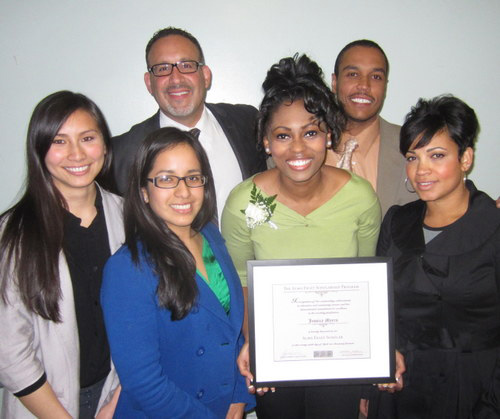
Jessica Myers, a senior at Southern Connecticut State University, was honored as the 2014 Alma Exley Scholar at a reception on April 29 in West Hartford. Five previous scholarship recipients were on hand to congratulate her.

Surrounding Ms. Myers in the photo above are, from left, Jessica Raugitinane (2012), Margaret Seclen (2013), Dr. Miguel Cardona (1998), Desi Nesmith (2000) and Violet Jimenez Sims (2008). Ms. Myers, a graduate of Cooperative Arts and Humanities High School in New Haven, is pursuing a Bachelor of Science in Education and a Bachelor of Arts in Liberal Studies, with minors in English and French.

Guest speaker at the reception was Jessica Raugitinane, a previous recipient who taught and did research in London during the fall 2013 semester in her final year of five-year Integrated Bachelor’s/Master’s Program at the University of Connecticut.

Ms. Myers, a member of SCSU’s Urban Education Fellows program, is exploring issues related to race, ethnicity, culture and poverty in education, which will prepare her to fulfill her goal of teaching in an urban school district.

Her energy and commitment have led her to be selected to teach in an after-school program in New Haven called Rain of Hope. This year she has been active in recruiting other minority students to pursue careers as public school teachers.

Ms. Myers is particularly interested in exploring educational methods that will allow her to make academic content relevant to her students. She is developing a curriculum to engage urban students in real-life problem solving.

Before entering SCSU, she studied at American Musical and Dramatic Academy in New York City. Since enrolling at SCSU, she has strengthened her fluency in French by studying at Cité Université in Paris. While meeting the demands of her academic and extra-curricular activities,

Ms. Myers works as a residential counselor at a group home for children and adults with disabilities. She has a bright future ahead of her, and we at the Alma Exley Scholarship Program are pleased to play a part in helping to launch her career in education.

UConn Senior Is Honored As 24th Alma Exley Scholar

Margaret Seclen, a student at the University of Connecticut, was honored as the 2013 Alma Exley Scholar at a reception on April 8 at the Elmwood Community Center, West Hartford.

Ms. Seclen, from Stratford, Conn., is completing her senior year by student teaching at Batchelder Elementary School, Hartford. She is scheduled to receive a B.S. degree in elementary education and a B.A. degree in history in the Honors Program in May. She plans to receive a master’s degree in education from UConn in May 2014.

Four previous recipients were on hand to honor Ms. Seclen, Dr. Miguel Cardona, principal of Hanover School in Meriden; Desi Nesmith, principal of Metacomet School in Bloomfield; Violet Jiménez Sims, Spanish teacher at New Britain High School; and Dr. Santosha Oliver, assistant principal at Robert J. O’Brien STEM Academy in East Hartford.

Margaret Seclen, center, with previous recipients, from left, Desi Nesmith, Violet Jiménes Sims, Dr. Santosha Oliver, Dr. Miguel Cardona

Margaret Seclen, center, with previous recipients who were on hand tocongratulate her, from left, Desi Nesmith, Violet Jiménez Sims, Dr. Santosha Oliver, Dr. Miguel Cardona

In expressing her thanks for the scholarship, Ms. Seclen said that she has always wanted to be a teacher. She recalled, as a five-year-old, trying to teach her younger brother how to read and write.

Ms. Seclen came to the United States from Peru at age 10. She attributed her early academic success to her fifth-grade teacher, Ms. Torres, a loving and nurturing woman who made her feel welcomed.

“Being a part of Ms. Torres’ classroom has influenced me to this day because I want my students to feel just as important and valued as Ms. Torres made me feel,” she said. “I want every one of my students to know that someone cares for them and that my classroom is their home. I want them to know that it’s okay to take risks and it’s okay to make mistakes. I want them to know that I won’t give up on them and that they will be successful.”

Ms. Seclen said research about the achievement gap suggests that minority students might not be meeting higher levels of academic performance because they often find schools to be alien and hostile settings.

This led her to focus her senior thesis on culturally responsive teaching practices. Teachers are using these methods to improve academic performance by minority students by allowing them to learn in meaningful ways, such as connecting classroom learning to their interests, prior experiences, and cultural backgrounds. These practices can range from building a sense of trust in students to critically examining the curriculum to determine whether it reinforces negative cultural stereotypes.

“I am lucky to be creating those trusting relationships with my students now,” she said. “I’ve seen that only after establishing these bonds can students be successful academically.

“Only because we care for and respect each other is it possible that a student can feel comfortable enough to share with me that her dad died after being stabbed when she was only three.

“Only because we care for and respect each other is it possible that one of the most disruptive students works hard to stay on task so he can have lunch with me.

“Only because we care for and respect each other is it possible that a student who always puts his head down and refuses to do any work, actually announces to the class that “Math is fun!” as he rapidly works to complete his fact families.

“Every day comes with its challenges, but with love, care, and determination, we’re able to overcome those obstacles in our way for the sake of learning and growing.

“All my experiences so far have shown me how vital education is in order to succeed in life,” she said. “Despite current trends, I still believe education to be the ‘great equalizer’ because it can empower all students to fulfill their dreams. Education helps children reach their full potential and has the ability to shape students into meaningful contributors to society.

“I consider myself extremely fortunate to have a direct role in this process of discovery and growth that children experience in their elementary school years, and I simply cannot wait for the day where I have my very own classroom.”

The guest speaker, Dr. Oliver, spoke about the mission of the STEM Academy in East Hartford, which is to encourage students to develop an interest in the fields of science, technology, engineering and mathematics. Excerpts from her remarks are posted in the “In Their Own Words” feature.